HUAQUEO
“Huaqueo” is an installation that addresses the destruction of cultural heritage and the process of deterritorialization of ethnological objects and images. It is inspired by the “Preuss Collection.” The word “huaca” in the Quechua language means, among other things, “local deity / sacred place,” and the verb derived from it, “huaquear,” means, among other things, “to excavate” in the sense of “to plunder,” also referring to the destruction of an archaeological site. “Huaqueo” – plundering – is a present and deeply rooted term in the culture of the Andean peoples. Huaquería, that is, looting, has largely destroyed our historical and cultural heritage.

Huaqueo: Installation, 3 transport crates, mirrors, glass, LED light, epoxy resin, wall tapestry, each box 110 cm x 70 cm x 70 cm | Photo: Jorge Sanchez Di Bello | 2024.
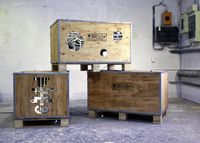
Huaqueo: Installation, 3 transport crates, mirrors, glass, LED light, epoxy resin, wall tapestry, each box 110 cm x 70 cm x 70 cm | Photo: Jorge Sanchez Di Bello | 2024.

Huaqueo: Installation | Photo: Jorge Sanchez Di Bello | 2024.
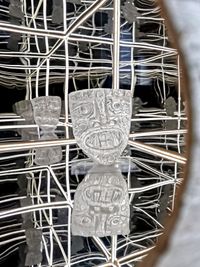
Huaqueo: Installation | Photo: Jorge Sanchez Di Bello | 2024.

Huaqueo: Installation | Foto: Jorge Sanchez Di Bello | 2024.
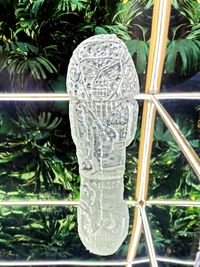
Huaqueo: Installation | Photo: Jorge Sanchez Di Bello | 2024
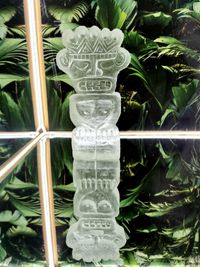
Huaqueo: Installation | Photo: Jorge Sanchez Di Bello | 2024.
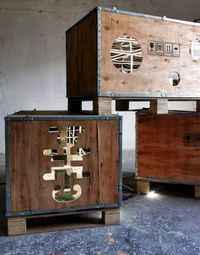
Huaqueo: Installation | Photo: Jorge Sanchez Di Bello, 2024.

Huaqueo:Installation | Photo: Jorge Sanchez Di Bello| 2024.

Huaqueo: Installation | Photo: Jorge Sanchez Di Bello | 2024.

Huaqueo:Installation | Photo: Jorge Sanchez Di Bello | 2024.
It is important to note that Preuss not only carried out the excavations, but also documented the site, describing the formology as well as morphological and/or anthropomorphic characteristics. As part of his research, Preuss made molds of some sculptures, which were later reproduced in Berlin. The molds were made of wood glue, starch, paper, and tree resin.
Huaqueo is a work that primarily addresses the destruction of cultural heritage and the process of deterritorialization of ethnological objects and images. It is an installation consisting of three wooden transport boxes that can conceal their contents or reveal them as a presentation space.
The installation is inspired by three thematic axes of creation:
- The meaning of Huaqueo/Guaqueo as a verb: plundering or excavation. This is also the title of the work. It should be emphasized that the decision to draw inspiration from these objects during this research and creation process is itself also a process of “excavation,” a form of extraction for production and reinterpretation.
- Huaquero/Guaquero as a subject: a person who devotes their time to the search, hunting, and excavation of buried and hidden history. And as a figure who takes advantage of the fortune of discovery to acquire wealth at the expense of the decay or loss of cultural heritage, even while knowing the value and significance it holds for the history of cultures.
- The Huaca/Guaca as an object: it is the treasure, the value, the history, and the place. It is the objects and the representation of wealth, the goal of the tireless search to discover what our ancestors left buried, the heritage we would never receive. In particular, my representation of the Huaca/Guaca is based on Colombian oral tradition about the myth of grave robbing.
Inside each box are two figures, modeled in clay and then cast in transparent epoxy resin. The boxes are internally illuminated and mirrored. The upper box is completely mirrored inside and contains two masks. On the left side, there is a mask reminiscent of the facial features of a bird, while the mask on the right imitates the face of a jaguar. Both display human and animal characteristics and are anthropomorphic. On the outside, there are three circular holes that allow the viewer, through a spy mirror, to observe the infinite effect of the world to which these representations belong. The circles can be understood as the sun, moon, and earth, as a worldview or indigenous cosmovision. The lower boxes contain additional elements. One box reveals its contents through two viewing elements cut in the shape of a stylized jaguar, showing two figures in the jungle. Again, through the interplay of light and spy mirrors, a man with a club or a guardian and a seated woman with imposing jewelry become visible. The second lower box has mirrored viewing elements in the shape of a poporo (lime container for coca consumption) and a vaulted door, as transcendental elements. It allows the viewer to witness two figures, one female and one male, as if they were gods staging a possibly ritual moment. Through the use of infinite mirror spaces in combination with light and stylized and newly created “indigenous” elements, I have thus created an approach to cosmological understanding in the context of the sober external observation of the transport of looted cultural goods.